

Needs by age
Every stage of a child’s life is crucial and should be approached with a full awareness of what is at stake—from the infant’s early oral discovery to the teenager’s growing autonomy, from baby teeth to permanent teeth.
Below, you will have the opportunity to become more familiar with each age group, its specific challenges, your role in supporting your child, as well as the approach we have put in place.
A playful approach. A relationship built on trust.
Newborns Aged 0 to 3
Discovering the world... and their mouth
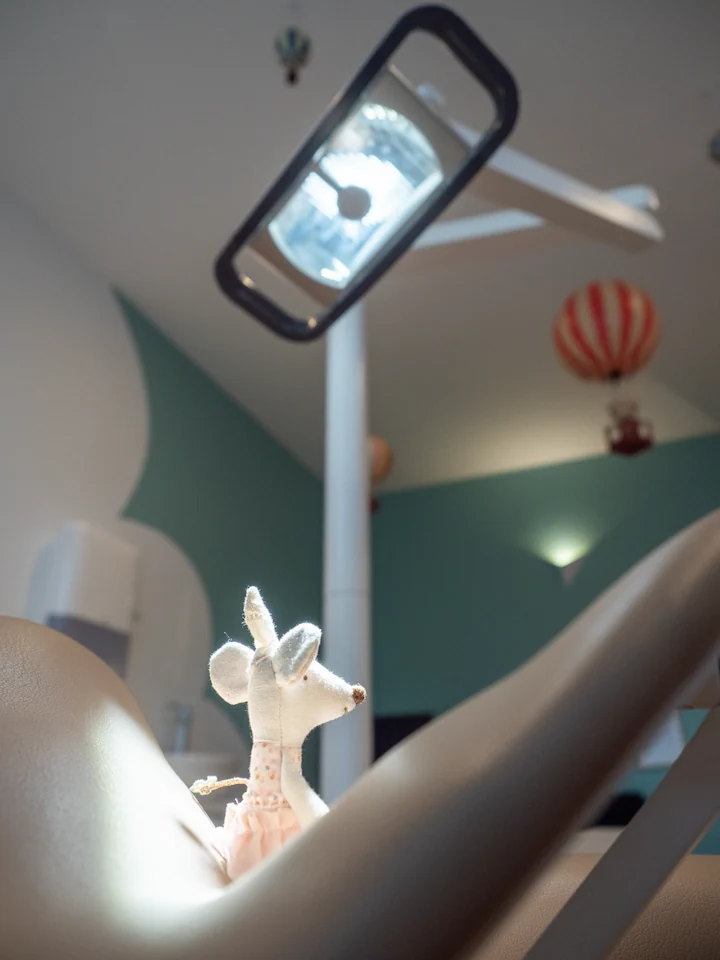
Their needs
- At this age, your child discovers the world through their mouth: tasting, exploring, and experimenting.
- Their diet begins around 6 months and gradually evolves (frequency, variety, textures).
- They begin to develop language and speech.
- As they learn to walk, falls and dental injuries may occur.
Our philosophy
Primary teeth begin to emerge around 6 months of age and are usually complete by age 3. Your child is welcome at the clinic as soon as their first tooth appears. This is a key time to address your first questions, monitor the evolution of your child's mouth, introduce simple preventive measures, and gradually establish good oral hygiene habits.
Your role
The aptly named “tender age” is a period during which enamel is still immature—very porous and soft. Cavities can develop quickly. Fruit juices, drinkable purées, drinkable yogurts, and sweets can all contribute to tooth decay.
Brushing should begin as soon as the first tooth appears, and toothpaste should be introduced with the eruption of the first primary molar.
We recommend stopping sucking habits (pacifier, thumb) once your child begins walking. By then, dietary diversification is already underway, and your child can swallow like an adult. Chewing should be encouraged to support proper oral development.
Children Aged 3 to 6
Growing, playing, imitating, and becoming comfortable with care
Their needs
Their world revolves around play and imitation.
You are their compass, and they rely on you for every stage of their development.
They need routines and comfort objects (such as a favorite toy or pacifier).
This stage is marked by entering group settings and the beginning of schooling. They gradually learn to manage without you.
Their attention span is short, and they have difficulty projecting themselves into the future.
Our philosophy
At this age, children do not yet have the emotional maturity to cope with situations that make them anxious. It is up to us, as adults, to adapt to their needs. To support this, our clinic provides visual and audiovisual distractions. In some cases, MEOPA sedation (a gentle inhalation sedation) may be used to help your child feel more at ease during treatment.
Their behavior can be influenced by fatigue or hunger, which is why we only schedule appointments for this age group in the morning. Children need familiar reference points, so no treatment is carried out during the first visit. Your child needs your trust in order to accept care, and you are present in the treatment room during each session.
Some children may find it difficult to cooperate at this age. Our role is to find the most appropriate approach for your child. This may involve postponing treatment until they are older, or considering care under general anesthesia if their condition requires it.
Your role
At this age, children imitate your behavior—often to an exaggerated degree. You are their model, and they will follow your example in every way: eating habits, relationship to their body and hygiene, as well as fears and anxieties.
This stage of childhood is ideal for establishing good habits: avoiding sugary drinks on a daily basis, setting regular, balanced meals without snacking, and establishing a routine of brushing twice a day. Children do not yet have the patience or dexterity to brush effectively. It is therefore your responsibility to brush their teeth morning and evening until around age 7.

Older Children Aged 7 to 12
Expressing the desire to be considered

Their needs
- They increasingly express the desire to be considered and and seek greater responsibility.
- They choose whom they trust.
Our philosophy
It is often easier for a child to seek help than to face their fears—yet they have the maturity to do so. We never perform any procedure in the mouth without first explaining and demonstrating it to the child. If they decide to overcome their fear, it is our responsibility to support them and show them they are capable. They will come away from the experience feeling proud and empowered.
Some children may need additional support. We offer MEOPA (gentle inhalation sedation) when anxiety is too overwhelming. At this age, your child is mature enough to be alone in the treatment room. This allows us to have their full attention. As trust takes time to build, no treatment is carried out during the first consultation.
Your role
It is natural to feel anxious about the unknown, but once your child understands what is expected of them, they need to allow us to provide care and trust us. Your role is to help them express their fears so that we can give them the tools to feel more at ease.
Brushing can now be done independently, but it should still be supervised. As always, the same causes lead to the same effects: please ensure sugary drinks, sweets, and snacking are kept to a minimum.
Adolescents Aged 13 to 15
Your teenagers are driven by a desire for independence
Their needs
- They no longer want to depend on adults and strongly value their independence.
- They tend to place less importance on personal hygiene.
- They develop new reference points (social media, friendships).
- They get bored quickly and are drawn to novelty.
- They may be more vulnerable to addictions and eating disorders.
Our philosophy
Our challenge is to gain their engagement in their care and help them become active participants in their own health. At this age, appearance is essential. We use intraoral photographs to highlight the role their smile plays in their identity. Taking care of their oral health requires effort, often alongside orthodontic treatment.
We recommend seeing them twice a year to help maintain their motivation. You are present in the treatment room for the first consultation. For all subsequent appointments, your teenager will be seen on their own.
Your role
Adolescence can be a challenging time for you as parents, and we are here to listen and support you. Your role is to ensure brushing twice a day is maintained and to limit the consumption of sugary foods and drinks at home.